Free Tool

Room Mode & Bass Trap Calculator

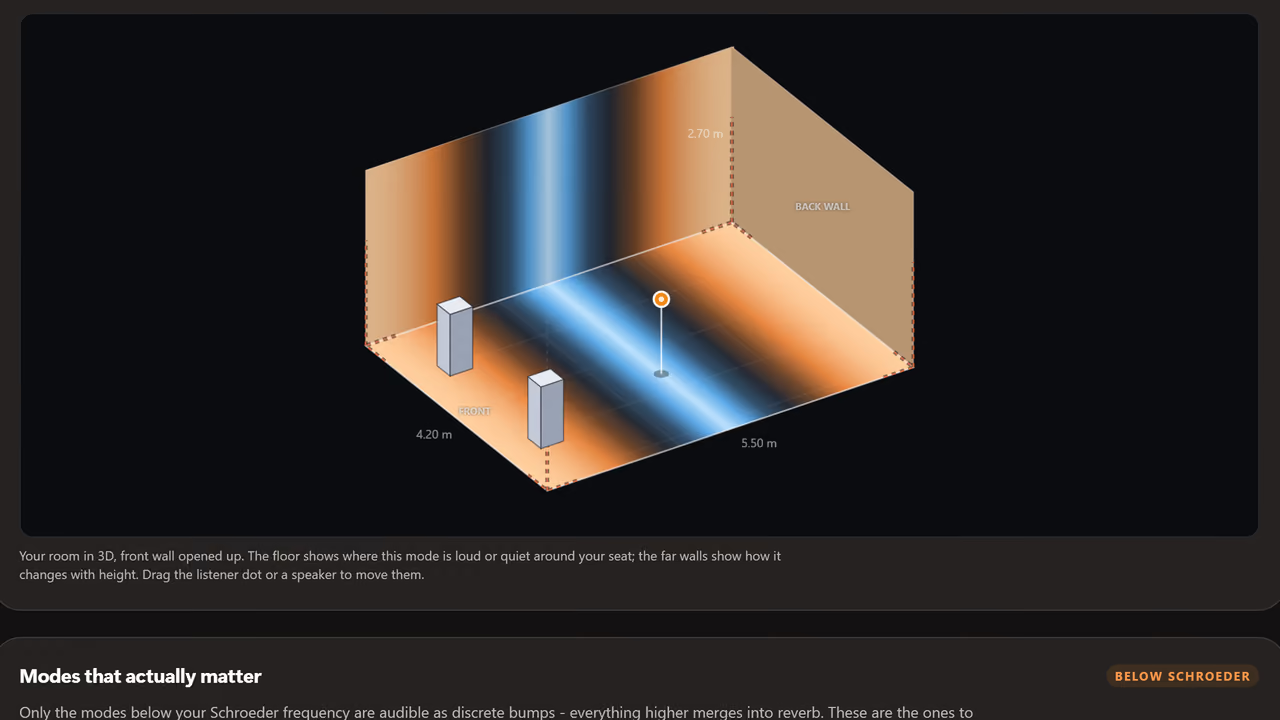
Enter your room dimensions to map every standing-wave resonance up to 300 Hz - axial, tangential, and oblique. The canvas visualiser shows pressure nodes (nulls) and antinodes (peaks) so you can see exactly where to sit and where to put bass traps.

Why it matters: room modes are the single biggest reason a great speaker can sound bad in a small room. A 30 dB peak at one frequency and a deep null at another, sometimes within centimetres of each other. Identify them, then treat or sit around them.

Room dimensions
Room properties

Typical untreated room: 0.4-0.8s. Well treated: 0.2-0.3s.

Speed of sound varies: c = 331.3 + 0.606 x T m/s

Pressure Distribution Visualizer

Select a mode below to visualize where pressure peaks and nulls are in your room cross-section. Red = high pressure (antinode), blue = low pressure (node).

Top view (Length x Width)
Side view (Length x Height)

How room modes work

The three mode types

Axial modes (strongest, -0 dB relative): Involve one room dimension only. A 5m room has its first axial mode at 343/(2x5) = 34.3Hz. Axial modes are the most audible and hardest to treat.

Tangential modes (medium, -3 dB relative): Involve two dimensions simultaneously. Less energy than axial but still audible.

Oblique modes (weakest, -6 dB relative): Involve all three dimensions. At higher frequencies these become so dense they merge into smooth reverb.

The Schroeder frequency

Above the Schroeder frequency, modes are so densely packed that the room response becomes statistically smooth. Below it, individual modes dominate and must be addressed individually.

The Schroeder frequency is approximately: f = 2000 x sqrt(RT60 / Volume). For a 5x4.2x2.7m room with RT60=0.4s, this is about 95Hz.

Bass trap placement

Place bass traps in corners - this is where all three axial mode antinodes (pressure peaks) coincide, maximizing absorption efficiency. Floor-to-ceiling corner traps in all four corners are the gold standard.

First-order axial mode by typical room size

The fundamental axial mode (single dimension) sits at f = 343 / (2 × dim). Below the Schroeder frequency, this mode and its harmonics define your bass response - change the room dimensions and you change the music.

Room dimension1st axial mode2nd3rdWhat it bumps
2.4 m / 8 ft (low ceiling)71 Hz143 Hz214 HzMale vocal fundamentals - boxy "in-the-room" voice.
2.7 m / 9 ft (typical ceiling)64 Hz127 Hz191 HzBass guitar low E (41 Hz unaffected; harmonics warm.)
3 m / 10 ft57 Hz114 Hz172 HzKick drum body, double-bass overtones.
3.5 m49 Hz98 Hz147 HzPipe organ / synth bass fundamentals.
4.2 m (typical width)41 Hz82 Hz122 HzBass-guitar low E exactly - boomy on every blues track.
5 m34 Hz69 Hz103 HzSub-bass region. Pipe organ pedals.
5.5 m (typical length)31 Hz62 Hz94 Hz5-string bass low B (31 Hz) sits on the mode.
6.5 m26 Hz53 Hz79 HzSub-bass; floor-to-ceiling traps still required.

FAQ

Room modes and bass treatment FAQ.

What standing waves do to bass response, how to find them, and the three ways to fix them in real listening rooms.

  1. What are room modes and why do they matter?

    Room modes are standing-wave resonances that build up at specific frequencies determined by your room dimensions. They cause uneven bass - a 30 dB peak at one frequency and a null at another, sometimes in the same listening position. They are the single biggest reason a great speaker can sound bad in a small room.

  2. How do I calculate room modes for my listening room?

    Enter your room length, width, and height in meters or feet. The tool calculates every axial (1D), tangential (2D), and oblique (3D) mode below 300 Hz, the most audible range. The visualizer maps pressure nodes (quiet zones) and antinodes (loud zones) so you can see where bass peaks and dead spots will be.

  3. How do I treat room modes once I find them?

    Three approaches: (1) Move the listening position to a node-free spot the tool highlights. (2) Move the speakers - corners excite all modes, away-from-walls excites fewer. (3) Add bass traps at the room corners and rear wall to absorb the worst peaks. Most rooms benefit from all three.

  4. What room dimensions are best for music listening?

    Avoid square rooms or rooms with two equal dimensions - they stack modes at the same frequencies and create huge peaks. Golden ratio proportions (roughly 1 : 1.618 : 2.618) spread modes evenly across the spectrum. The calculator visualizes mode density so you can compare different aspect ratios for your build.