Free Calculator

Speaker Amplifier Power Calculator

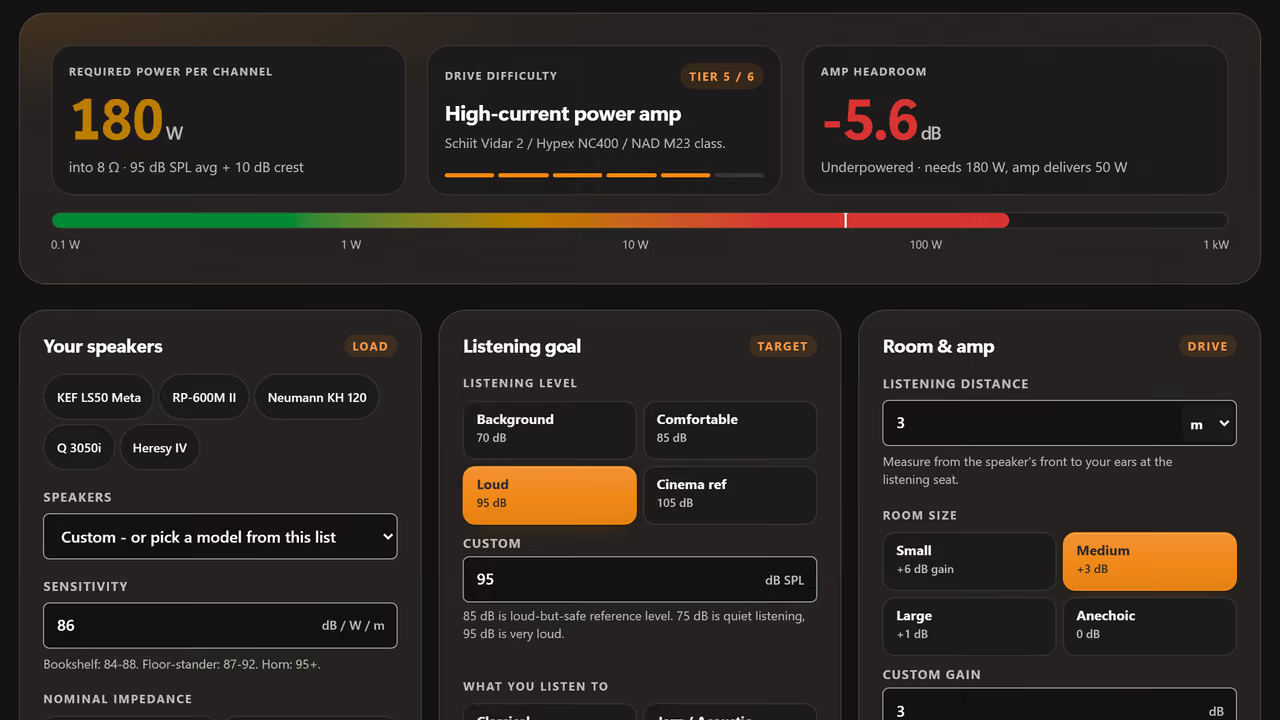
How many watts your speakers actually need to hit your target SPL at the listening chair. Solves the inverse square law against speaker sensitivity, room gain, and music crest factor so you size your amp to the room - not to a marketing spec.

Quick example: An 86 dB/W/m bookshelf at 3 m targeting 95 dB average with a typical 10 dB peak headroom and 3 dB of room boundary gain needs about 22 W per channel. A 90 dB/W/m floor-stander in the same setup gets there on under 9 W.

Typical bookshelves: 84-88 dB. Floor-standers: 87-92 dB. Horn / high-efficiency: 95+.

Nearfield: 1 m. Home listening: 2.5-4 m. Large rooms: 5 m+.

Background: 70. Comfortable: 80. Loud: 95. Cinema reference: 105.

10 dB for music transients. 20 dB for full cinema dynamics.

Real rooms add 3-6 dB at low frequencies. Use 0 for outdoors or anechoic.

Sizing the amp for the speaker, room, and target SPL

The math behind the number

Required amplifier wattage per channel comes from P = 10^((target − sensitivity + 20·log10(distance) − room_gain + headroom) ÷ 10). Every 6 dB of distance gain (doubling distance) costs 4× the power. Every 3 dB drop in sensitivity also doubles your power need.

The "headroom" field is critical. Music averages 15 dB below its peak; a 100 W amp running 100 W average will clip every transient. Aim for headroom that puts your average load around 10-25% of the amp's continuous rating.

Room gain and why specs lie about it

Manufacturers measure sensitivity at 1 m in anechoic conditions. Your room is not anechoic. A typical living room adds 3-6 dB of low-frequency boundary gain, which effectively raises your speaker's sensitivity below 200 Hz. Large, well-treated rooms behave closer to free-field and demand more amp power to match the same chair SPL.

For a stereo pair at the same chair, both speakers contribute. The calculator returns per-channel watts; total system draw is roughly 2× that on heavy passages. Cross-check the result with the SPL distance calculator for a sanity pass.

Reference speaker sensitivities, by class

Sensitivity drops the same amp twice between an 84 dB studio monitor and a 96 dB horn - same target SPL, 16× the watts on the low side. Numbers below are class-typical, not specific to any one model.

Speaker classSensitivityTypical at 3 m, 95 dB target
Compact bookshelf monitor82-84 dB40-80 W per channel - most demanding.
Mid-tier bookshelf85-87 dB20-40 W per channel - common home territory.
Floor-stander, dome tweeter87-90 dB10-25 W per channel - easy match.
High-efficiency floor-stander91-93 dB5-12 W per channel - flea-watt SET friendly.
Pro/PA cabinet94-98 dB2-8 W per channel - single tube driver wakes them up.
Compression-driver horn (Klipsch Heritage, Avantgarde)99-105 dBUnder 2 W - milliwatts move them.
Field-coil / large horn105-110 dBSub-watt territory; 300B SETs at idle.

FAQ

Speaker amplifier power FAQ.

How sensitivity, distance, and room gain change the watts you need, plus how to choose between a 50 W and a 200 W amp for the same speaker.

  1. How do I calculate the amplifier power my speakers need?

    Enter speaker sensitivity in dB/W/m, listening distance, and target SPL at the chair. The calculator runs the inverse square law to find the wattage required, then adds a headroom factor for music transients. Match an amp whose continuous output meets or exceeds that figure into the speaker's nominal impedance.

  2. How does sensitivity reduce the amplifier wattage I need?

    Every 3 dB of speaker sensitivity halves the amplifier power required for the same SPL. An 89 dB/W/m speaker needs only half the watts of an 86 dB/W/m speaker. High-sensitivity horns at 95+ dB can reach reference levels on a single watt; insensitive 83 dB monitors will need triple-digit wattage in a large room.

  3. How much headroom should an amp have over my calculated power?

    Target 2-4x the calculated continuous power as peak amp capability. Music has 15-20 dB of crest factor; an amp that hits the calculated number on average will clip on transients. A 100 W RMS amp that doubles to 200 W into a 4-ohm speaker is ideal for 50 W average loads.

  4. Does room size and treatment change how much power I need?

    Yes. A small treated room adds 3-6 dB of boundary gain at low frequencies, effectively boosting your sensitivity. Large or anechoic rooms behave closer to free field and demand more power. The calculator includes a room-gain field so you can dial in your environment.

  5. What about clipping headroom and amplifier classes?

    Class A, AB, and D all clip ungracefully if pushed past their continuous rating. The "watts" in the calculator should be clean RMS into the speaker's impedance, not peak music power or PMPO marketing numbers. For the most demanding speakers (low sensitivity, low impedance), high-current amps that double their wattage at 4 ohms are the right pick.