This SPL distance calculator shows how loud your speakers actually play at the chair, with all the physics dialled in: speaker sensitivity (how loud one watt plays at one metre), amplifier wattage, distance, room boundary gain (the bass lift nearby walls add), and stereo pair summation. Drag the dot on the chart to set your seat and watch the SPL update live.
New to this? Pick your speakers from the chips below, tell it how far you sit, and read the big number - that is the loudness at your chair, with a plain verdict on how long that level is safe.
My rigs
Save speaker+amp+room setups here. Useful when you're swapping speakers or considering a new amp.
Clean RMS into the speaker's nominal impedance. Use 1 W to read the speaker's 1 m sensitivity directly.
Room & target
tune
Or drag the dot on the chart below to set this visually.
SPL falloff with distance
drag to set
Log distance axis - the inverse-square line comes out straight. Drag the dot to set your listening distance and watch every number above update live. The dashed orange line is your target SPL; where it crosses the curve is the seat position that hits your target exactly.
Average SPL (with room gain)Peak SPL (+6 dB crest)Your targetWHO 85 dB safe
Show the math
How distance and room gain shape SPL at the chair
The inverse square law
In free space, doubling distance from a point source costs you 6 dB. A speaker at 86 dB/W/m drops to 80 dB at 2 m and 74 dB at 4 m. A cinema seat at 5 m needs about 14 dB more output than a nearfield chair at 1 m to hit the same level - that's a 25x power requirement, not a doubling. The chart's log x-axis makes the inverse-square line straight; if your curve isn't straight, the chart isn't honest.
Real rooms add room boundary gain: 6 dB in small treated spaces, 3 dB in typical furnished rooms, ~1 dB in large rooms. The room-size pills set sensible defaults; the custom field lets you trim for your actual space.
Stereo pair, headroom, and safe-listening time
A stereo pair sums about +3 dB at the chair (correlated content). Crest factor matters: the peak-SPL line is the average + 6 dB, so a 95 dB average reading means real-world peaks bumping 101 dB. Your amp has to deliver those peaks cleanly - clipping them spells driver damage faster than the peak SPL alone implies.
WHO safe-listening time uses the 85 dB / 8 h baseline with a 3 dB exchange rule: every +3 dB halves the safe duration. 95 dB at the chair = 47 min/day. 105 dB = 4.7 min/day. The safe-time pillar above tells you how long you can listen at the current SPL before crossing the daily-dose line.
SPL reference points, in things you've heard
Anchor numbers: what every dB level actually sounds like.
30 dBWhisper
Quiet bedroom at night. Noise floor of a treated room.
60 dBConversation
Normal speaking voice at a metre. Background office.
75 dBLate-night
Hi-fi at low volume. Neighbour-friendly.
85 dBCinema ref
Movie average. WHO long-term safe ceiling.
95 dBLoud music
Rock club at the bar. 47 min/day safe.
105 dBCinema peaks
Action sequence transients. Front-row arena.
115 dBLive concert
PA at full tilt. 30 s before daily dose blown.
130 dBPain
Jet engine at 30 m. Damage in seconds.
Why sound gets quieter with distance - and by how much
In free space, sound spreads over a sphere whose area grows with the square of the distance. The same energy covering four times the area means a quarter of the intensity, which is a 6 dB drop every time the distance doubles. That is the inverse-square law, and it is the baseline every other effect is measured against.
A room breaks that baseline. Close to the speaker you mostly hear the direct sound and the 6 dB rule roughly holds; further away, reflected energy accumulates until the level stops falling much at all. The changeover is the critical distance, and in a typical domestic room it arrives sooner than people expect.
That is why level at the listening seat is not a speaker specification - it is a property of the speaker, the distance, the room, and the amplifier together. Measuring at one metre tells you about the speaker; this tells you about the chair you actually sit in.
Worked example
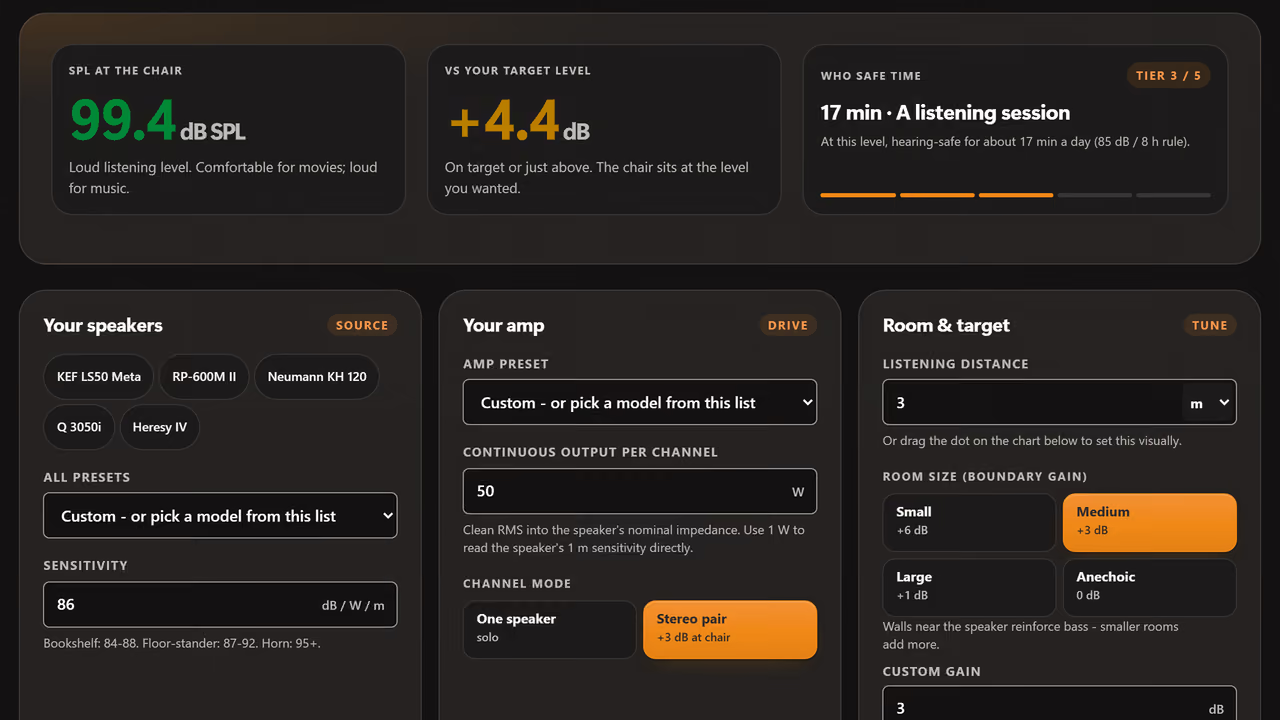
An 86 dB sensitivity speaker at 3 m, as a stereo pair with 3 dB of room gain, from 50 W per channel, against a 95 dB target.
SPL at the chair 99.4 dB, which is 4.4 dB above target, and hearing-safe for about 17 min a day.
Sensitivity, distance, pairing and room gain all land in this one number, which is why two systems that look alike on paper can sit 10 dB apart at the chair. The safe-time row is the reminder that hitting the target is not the same as wanting to sit in it.
The ideas behind the controls
Inverse-square law
Free-field sound loses 6 dB per doubling of distance. Halving your listening distance is worth as much as quadrupling amplifier power.
Critical distance
The distance at which reflected energy equals direct energy. Past it, moving further away changes level far less than the arithmetic suggests.
Room gain
Low-frequency reinforcement from walls, floor and ceiling. It rises as the room gets smaller and as the speaker gets closer to a boundary.
A-weighting
A filter that discounts the frequencies human hearing is least sensitive to, so a dB(A) figure tracks perceived loudness better than an unweighted one.
Speaker SPL and distance FAQ.
How loud your speakers actually play at the chair, how much amp power you really need, and why spec-sheet sensitivity overstates the room reality.
How loud will my speakers be at the listening position?
Sound pressure drops 6 dB every time the listening distance doubles in a free field. Enter your speaker sensitivity (dB SPL/W/m), the amplifier wattage, and the chair distance. The calculator returns the SPL at your ears, accounting for inverse-square falloff plus the room boundary gain you pick (Small +6 dB down to Anechoic 0 dB) and, for a stereo pair, the extra 3 dB of summation.
How much amplifier power do I need for my speakers?
For 88 dB/W/m speakers at 3 m wanting 100 dB peaks, you need around 100 W per channel. Halve the sensitivity (-3 dB) and you need double the power; double the distance and you need quadruple. The calculator handles all three variables, and it plots a peak line 6 dB above the average so you can see where transients land against your target level.
What is speaker sensitivity in dB/W/m?
Sensitivity is the SPL a speaker produces with 1 watt of input measured at 1 meter on-axis. 86 dB/W/m is below average; 88-91 dB is mainstream; 93+ is high-sensitivity (horn-loaded, large drivers). High sensitivity speakers need much less amplifier power for the same loudness.
Why do my speakers sound quieter than the spec suggests?
Spec sheet sensitivity is measured anechoic at 1 m on-axis. Your room adds bass gain but eats midrange via absorption and dispersion, and 1 m is closer than any real chair. The calculator adds the room gain you pick (+3 dB by default) and uses your real chair distance, which is closer to what you actually hear.
How do I read the SPL falloff chart on this calculator?
The x-axis is listening distance on a log scale, the y-axis is SPL in dB. The thick curve is the average SPL with room gain, and the thin line above it is the +6 dB peak SPL for music transients. Two dashed lines cross the plot, each labelled on the chart: your target level, and the WHO 85 dB reference. The marker dot is where your current listening distance lands, and you can drag it along the curve to set the distance.
Does the inverse-square law apply indoors?
Partly. In the direct-sound near-field (typically within 1-2 m of the speaker indoors) sound drops 6 dB per doubling of distance just like free-field. Beyond the critical distance the reverberant field dominates and the level becomes nearly constant with distance. That is why a small treated room sounds louder at the back wall than physics would predict. The calculator models the inverse-square component plus a simple room-gain term; for full reverberant-field accuracy a measurement microphone is the answer.